Showing posts with label Santa Barbara Island. Show all posts

Monday, October 14, 2013

Cats and Ice Plants

"HELLO."  I called out, a little nervous that I might get kicked off the island. 

Pete had long hair and a maroon sweatshirt. He regarded me with suspicion, explaining the facility was closed (due to the government shutdown). Luckily, the Pygmy Mammoth charmed him, and he decided to give me a short tour.

Untitled


Pete is a contractor for native plant restoration on Santa Barbara island. "All the plants look dry and dead, but they are just hibernating." He explained, spanning his arm around the landscape. 

Then he pointed to a green patch with yellow flowers below the nursery. "Except right below the nursery irrigation, where the Giant Coriopsis are constantly blooming." 

Giant Cori-op-sis… I rolled the name in my tongue. It sounded like (and looked like) a Dr. Seuss creation.


Screen shot 2013-10-14 at 10.09.42 PM
The Giant Coriopsis in bloom at the bottom of the leach field

"Where do you get your freshwater?" I asked. 

Pete explained that the National Park Service boat brings large vats of fresh water from the mainland, and they pump it up to tanks on the top of the hill.  

Do they get hot showers with such limited water?  No way.  They save the precious water for the native plant nursery. Bathing was done directly under the pier, in the 60 degree ocean water.


Screen shot 2013-10-05 at 6.44.01 PM
A meticulous nursery!

"Sounds like the boat!" I laughed. At least on the boat we use a solar shower -- a black bag of fresh water with a spigot, that heats up during the course of the day. Surely they could afford a few gallons a day for that basic of luxury? 

Katie walked up from the Ranger station.  She is a bird biologist.  Her organization is funded by the Montrose Settlement, the result of a DDT chemical spill in the Santa Barbara channel. This settlement has funded millions of dollars of restoration work in the five islands in the National Park system. 

"The funding ends in 2017. Just like that, it will be over,"  she looked towards the center of the island, and nodded optimistically. "But I think we will make it."

"What do you mean?" I asked, wondering what the goal was. 

Untitled
Nesting seabirds get right of way


"We just want the island to be self-sustaining. The native vegetation needs to be well-established, to provide good habitat for the nesting sea birds. We used to have one of the largest populations of Scripp's Murrelet's here."

Scripp's Murrelet's are fascinating little seabirds that travel in pairs. One of their main homes is Santa Barbara Island.

Pretend your whole extended family lives in one village.  Then it is invaded by large furry animals who like to eat your kids. 

"The cats were eating all the eggs, since the seabirds nest on the land. It was easy pickings. Not a very fair match. We did a big program to capture the feral cats, originally brought in by the sheep ranchers. The last ones were hiding in the southern valley of the island -- that's why it's called Cat Canyon," Katie said.

Screen shot 2013-10-05 at 6.45.18 PM
The view from Katie's office

I turned to Pete. "What about the plants?" 

"Ice plant is the main culprit," he began. "It's an annual plant that releases a lot of salt into the ground. This has drastic effects on soil chemistry. It becomes a great environment for ice plant but terrible for native plants. We've physically removed tons of ice plant, but it's tough to get ahead."

The equation is pretty simple. Cats + ice plants = bad for sea birds.  Native vegetation = good for sea birds. 

Its simplicity and small size means Santa Barbara Island might become a success story. It is also a fascinating place to start my trip comparing the restoration of the eight Channel Islands.  It raised 2 big questions in my mind. Maybe these could be guideposts for the rest of the trip.

-------

1) What is the goal of restoration?

The islands were different 100 years ago, 500 years ago, and 20.000 years ago.  Are we trying to restore the Island Fox or bring back the extinct Pygmy Mammoth?  
There are 4 years left of funding to finish the restoration work.  What does a healthy relationship with the islands ultimately look like?

2) What caused these sudden changes?

Ranchers innocently brought cats to the island. Small cause --> huge effect. Why are dogs less "bad"?  What is the mechanism that causes sudden changes, and how we do prevent them from happening?

--------


Untitled

Chris and I paddled the kayak back to Aldebaran. As we pulled anchor, we saw our biologist friends walking along the steep ridgeline towards a restoration site.  Just two of them in this isolated island.  

I looked forward to our return to Santa Barbara Island on our trip back North. Perhaps the grass will be lush and green if the rains come before our return. 

Thursday, October 10, 2013

When Sea Lions Climb Hillsides (and swim with humans later)


"Go swim with the sea lions at the Reserve," said Andy from the harbor dive shop.

I was in for a surprise.  Sure enough, they got amazingly close.  But what I didn't expect to see were the sea lions on top of the hill -- way way above the water!

Dirt darkened by their shuffling flippers, carving out terraces and pathways, they milled around the hillside. What were they doing way up there?

On the opposite northwest side of the island, we observed these Hillside-Dwelling Sea Lions in a chaotic display:


Scores of sea lions were on the ridgeline. They made their way down to the rocks.  Their "highway" was like a natural Slip & Slide, which went through a huge flock of cormorants. The birds grew restless, flapping their wings. Poor things, they can't fly from a standing start.  So they intersected the path of the sea lions in order to jump off the cliff, like hangliders. This caused a massive traffic jam. A flurry of flapping wings and barking sea lions ensued for ten minutes.

What motivated these sea lions, I wondered, to carry their heavy blubbery bodies up to the top of the hill?  Perhaps it was a "King of the Hill" mating ritual that turned into a societal norm.  Who knows, in 10.000 years they might have erected mud huts and thrones!

"On a small island, one cannot question the ways of evolution," says the Pygmy Mammoth.


Back in their natural element, they came to investigate when I jumped into the water with a snorkle. The juveniles kept swimming closer, making last minute turns, as if challenging each other to get closer to this foreign creature. Their eyes were big and bright. Maybe even having fun?

That joy made the island feel alive.  I've been in places where things feel dead, decaying.  This felt exuberant, flourishing. Maybe that is a measure of how healthy Nature is... alive-ness.


Wednesday, October 9, 2013

Imaginary Fences in the Ocean


Father and son with lobster traps aboard the Merlin

"It's been a weak start so far," said the captain of the Merlin, about the lobster season this year. He was pulling up a cage with 5 good sized lobster. He conceded: "Although today is looking more promising."

Seasonal closures are a costly limitation for fishermen, but they allow the lobster population to strengthen. They are accepted and well-regulated.  However, there is a new rule in the game: marine protected areas (MPAs).


The Pygmy Mammoth doesn't like fences, but understands they make good neighbors.

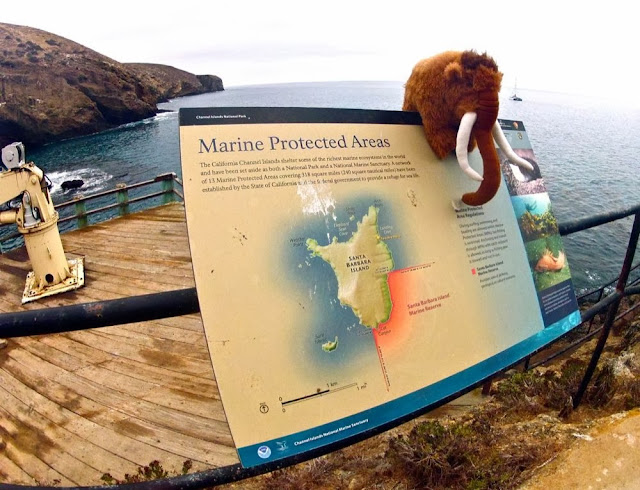
Check out the map: the Marine Protected Area is the red rectangle extending from the south-east corner of the island. There is no fishing in this area.  Naturally, fishermen hate this. As a sailor, if someone told me I'm not allowed in some rectangle of coast, I would also be quite upset.  That is what fishermen are experiencing. 


Marine ecologists, however, tell us that MPAs are essential. Government policy has followed suit, and now there are lines in the ocean, shown by GPS coordinates. They are like imaginargy fences, where some or no fishing is allowed. 

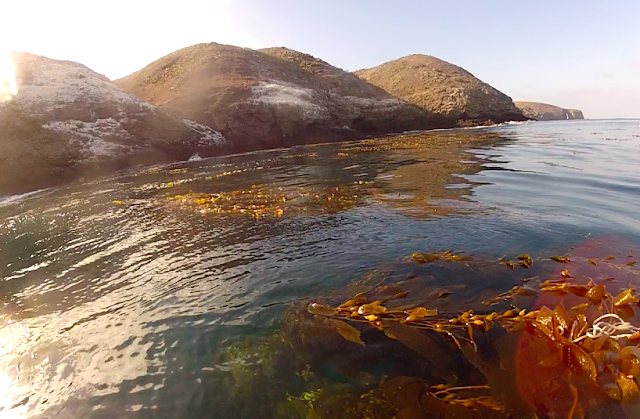
Kelp bed south of the main anchorage, with Arch Point in the background

Later in the day, Chris and I paddled the tandem kayak from the main anchorage towards a nice kelp bed. We dove with our hawaiian slings, and came up with 2 perch and 1 fat sheepshead. Needless to say, we were outside of the reserve!  

After we gutted and scaled them, the fish turned into ceviche, a risotto, and a barbecue fillet dinner. It is good to be close to the source of our food, and get the atavistic feeling of a hunter-gatherer. That is a feeling that is vanishing from our world. Lobster fishermen like the captain of the Merlin are some of the last hunter-gatherers, living in the wild ocean to bring seafood to our plates. 


Sutil Island, on the right, is an rugged islet on the south-west corner of Santa Barbara Island

Sitting in Aldebaran, I looked south and imagined a fence running along the ocean with virtual "No Fishing" signs along it.  

Fences -- like seasonal closures and MPAs -- are unwelcome constraints for the free spirited fishermen. As management techniques, none are perfect. But they are attempts to keep seafood on our plates (and a life in the ocean) into the future. 


Government Shutdown and Arrival in SB isle

Happy to get off Aldebaran (that little speck at anchor in the background), Pygmy Mammoth admitted to being a little sea sick.

The Pygmy Mammoth made it to Santa Barbara Island!

We were greeted with the following sign:

"Due to the federal government shutdown, this facility is closed."

Anarchy is not my forte, but after 11hrs of sailing, I wasn't about to turn back. I climbed the ladder to the rudimentary dock, the only landing on the island.

I first heard the news as we fueled Aldebaran in the harbor, just prior to departure: "Does this mean the IRS is also closed?" laughed the fuel dock attendant. We were raising sail ten minutes later, salt spray on our eyes, laying rest our worries about societal collapse. 


A warm welcome from one of our nation's most inaccessible National Parks

The bureaucratic beast would rear up its head soon enough -- we were still applying for access to the Navy-controlled San Clemente and San Nicolas islands. But this caught me off guard.  A beloved National Park, closed, after all this effort!

"What do you think about all this?" I spoke aloud to the island, now solidly under my feet. 

A memory came to me. Do you know that book about how Nature comes back when humans are gone?  That possibility is fertile in this isolated chunk of land. But is that what the island wants?  Should we be good stewards of the land; is our restoration work bringing real benefit?


Prompted by our government's vacation, these were good questions to start the journey.  Restoration costs millions of dollars. We need to know why we are doing this.

Spectacular and controversial programs have occurred in each of the eight channel islands, with varying levels of success and challenges. I hoped to learn the deeper Why and How of Restoration, by visiting them in my sailboat; ultimately, to appreciate these fantastic islands and to see what they teach us about the art of dealing with change.

Was there anyone on this island to discuss this question, or would I just keep talking to myself?

After walking up the hill, I found two people. 

Sunday, October 6, 2013

Four crew... 63 miles to SB island

Here's our crew and route for the first leg of the trip:


The voice of unreasonable wisdom was from my own dad, Bob Beadle, who joined us on the trip to "keep an eye on things."

He steered Aldebaran when we were flying at 8 knots enroute to Santa Cruz island, where we made a pitstop. When conditions aren't thrilling, he gets bored and can be found reading "Voyage for Madmen" inside the cabin.   He makes a mean risotto and secret pancake recipe, as we discovered on days 2 and 4. 


Chris Colajezzi is a lifeguard from Los Angeles joining us on the October cruise, a solid guy, chill, hard-working, good company. On the 7hr, 40mile stretch across lonely ocean to Santa Barbara Island, he was fixing the man-overboard pole and rigging the life ring. Safety first!  Chris seems right at home repairing things underway; because that's how we roll on Aldebaran.


The good ship Aldebaran wouldn't be sailing the high seas without Ed's persistence for "gumption", a quality he brings as director of the Santa Barbara Bicycle Coalition (and boat partner). Gumption is togetherness; it is lastingness; it is maintenance-free-ness.  He grew up sailing with his dad in Catalina; the journey south is a long standing dream, uniting his past, environmental work, and life in Santa Barbara. 


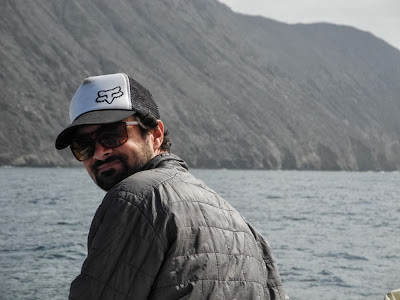
This is me.  I remember the summers that I spent with my grandparents in a small cabin in an island. Since then, islands have always fascinated me. Surrounded by ocean, I felt butterflies in my stomach when I sighted Santa Barbara island in the haze. Then she grew in front of us. Just 63 miles south of Santa Barbara (the town), she is rarely visited, as most people sail straight to Catalina. It is a forlorn, water-less land. But like a poor man's oasis, it is full of life when we look closer. 


Day 1: Santa Barbara to Santa Cruz Island (23nm). The wind was 12-15 knots, beautiful sailing, clear skies, departing 4pm, arriving 7:30pm at Smuggler's Cove. 
Day 2: Santa Cruz Island to Santa Barbara Island (40nm). Light north breeze had us motor-sailing south to make sure we'd arrive before dark. Departure 10am, arriving 5pm at the main landing in Santa Barbara Island.
Day 3-4: In Santa Barbara Island, anchored at the Main Landing, we circumnavigated the island twice.